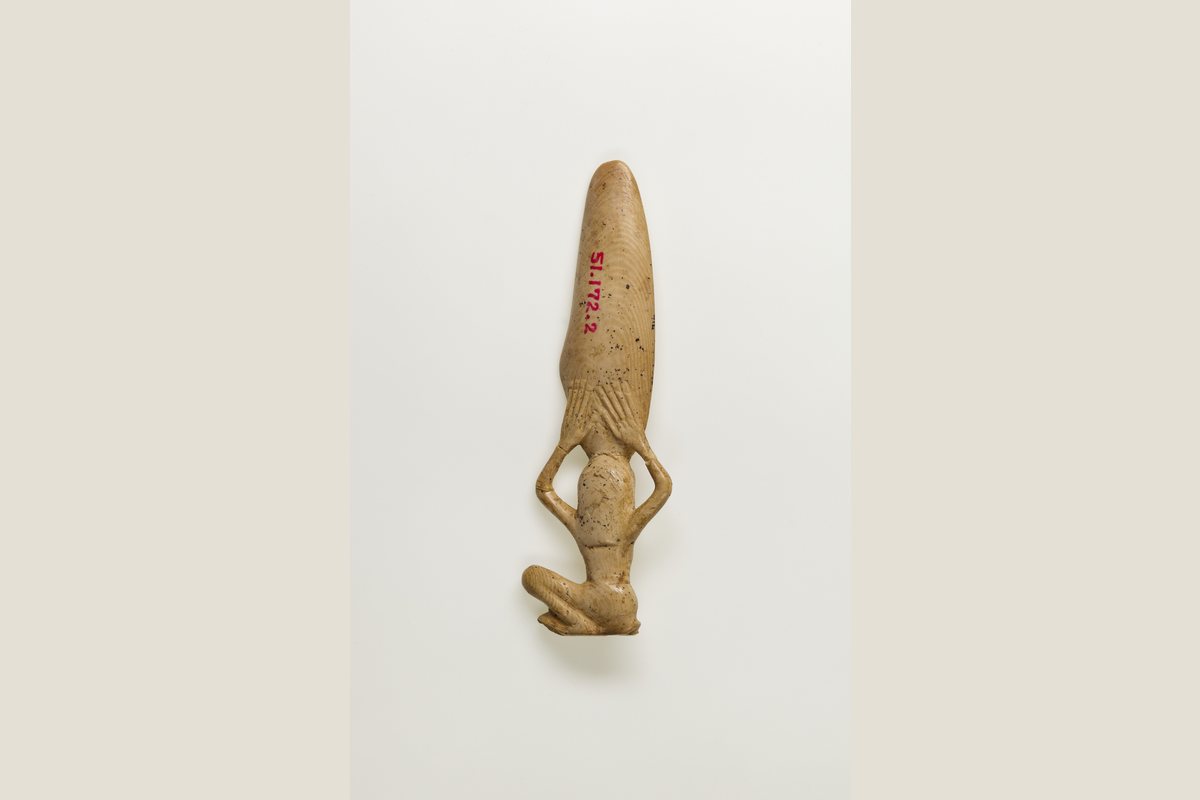
Bowls, tools, mirrors, cosmetic implements, writing equipment and small figures often occupy the scale of one or two hands. Their forms seem to demonstrate use, but an object can be ceremonial, modelled, repaired, repurposed or handled by someone other than the named owner. Read affordance—the actions a form makes possible—then test it against wear, contents, archaeological setting and the museum’s identification.
Measure reach and capacity
Record length, width, depth and weight if the museum provides them. A handle’s diameter, vessel opening or spoon bowl changes the action the object supports. Do not imitate the gesture against the case. Draw a side profile and mark grip, load and working edge as hypotheses. Physical possibility narrows interpretation but does not prove the action actually occurred.
Find the centre of balance
An object may be designed to pour, scoop, strike, reflect, write or present something while held at a particular angle. Shape and material distribute weight even when the case prevents testing. Look for thickened zones, counterweights and asymmetry. A missing attachment can radically change balance, so reconstruct only when the label, surviving join or strong comparison supports it.
Read openings and edges
Rims, spouts, blades, narrow necks, palettes and recessed bowls control contact with liquids, powders, fibres or other surfaces. Note sharpness, rounding, residues and repairs without naming contents by form alone. Residue analysis, inscriptions, associated finds and textual evidence can strengthen a functional claim. The noun on a label is an informed identification, not permission to invent every step of use.
Separate depicted body from using body
A cosmetic spoon shaped as a swimming woman presents a body while also operating at hand scale. Image, handle and container may guide different orientations. Ask which parts are seen during use, which meet the hand and which carry contents. Avoid treating the depicted action as a literal instruction. Form can transform social and visual ideas rather than simply illustrate an everyday scene.
Add maintenance to the gesture
Sharpening, cleaning, restringing, patching and replacing handles belong to use. Worn tools may change dimensions and balance over time. A repair can extend access or redirect function. Distinguish ancient maintenance from archaeological reconstruction and modern conservation where records allow. The object’s most informative human-scale action may be care rather than the dramatic use implied by its modern name.
Ask who handled it for whom
Commissioner, owner, user, attendant, craft worker and burial recipient need not be the same person. Titles or names can establish association without identifying every hand. Context may indicate restricted, household, administrative or ritual access. Write ‘made for,’ ‘named for,’ ‘found with’ and ‘probably used as’ only when each relationship has appropriate evidence.
Compare working and representational versions
A model tool, offering vessel or ceremonial implement may reproduce a familiar form at altered scale, material or finish. Compare it with excavated working examples before assuming identical performance. Difference can reveal which feature mattered symbolically or visually. Similar outline does not erase different contexts, and a prestigious material may make practical action less likely rather than more intense.
Write an action chain
List five verbs the form permits, then attach one observation or source to each. Remove any verb supported only by modern expectation. Add one maintenance action and one storage action. The resulting sequence will be less cinematic but more accountable, showing exactly where another label, catalogue entry or technical study could improve the reconstruction.
Compare more than one orientation
A hand-scale object can lie flat, hang, rotate, pour or be viewed from above. Museum mounts usually select one stable orientation for care and legibility. Note that choice and use joins, wear and institutional diagrams to test alternatives. Do not rotate the story merely because the object’s image suggests movement; separate physically possible positions from documented use.
Use published dimensions. Respect barriers. Separate present display, documented original setting and later digital enlargement.
Institutional sources reviewed 29 July 2026: National Museum of Egyptian Civilization ↗ · Egyptian Museum ↗. Displays and visitor conditions may change.