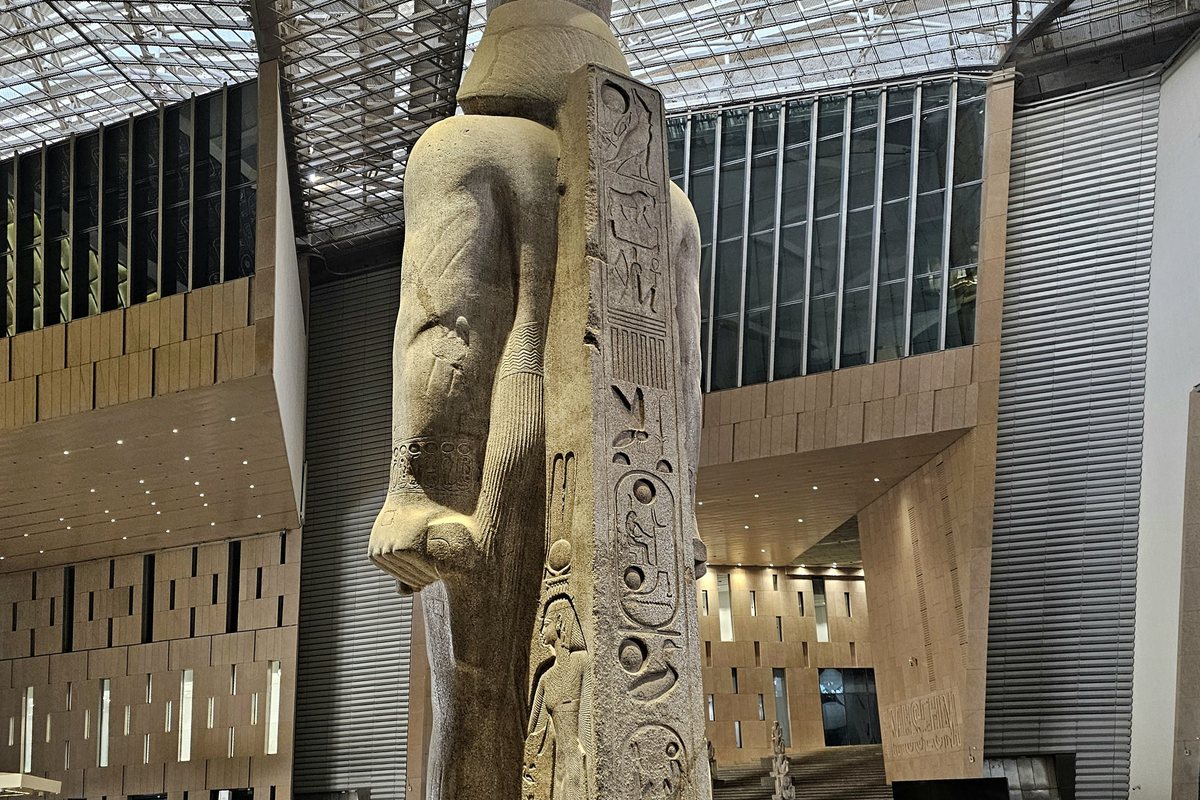
Monumental is not just a synonym for large. A colossal statue, gateway or architectural complex organizes distance, labour, movement, authority and landscape beyond the limits of one body or camera frame. Museums may bring a colossal element indoors, where roof, stairs and crowds supply new comparisons. Read mass and viewpoint carefully while remembering that the surviving fragment once belonged to a larger system.
Measure the visible element
Copy stated height, width, depth, mass and material where available. Separate the surviving element from reconstructed total height, plinth and current building. A low-angle photograph exaggerates verticality, while a distant view can hide surface detail. Use a diagram with a clearly labelled human silhouette only when the dimensions are known, not as decorative proof of grandeur.
Find the designed distance
Deep carving, enlarged features, bold inscription and simplified planes may respond to viewing from below or across open space. Move through permitted levels and note when features resolve. Do not call proportion incorrect before considering planned viewpoint. A museum balcony can provide a view unavailable to an ancient visitor, revealing construction while creating a new visual authority.
Turn mass into logistics
Quarrying, rough shaping, transport, finishing, erection and maintenance require infrastructure and coordinated labour. Avoid reducing this to a miraculous feat or one ruler’s command. Ask what roads, waterways, ramps, tools, supplies, records and specialist teams the evidence supports. Material source and final location are endpoints, not a complete transport narrative.
Restore the missing complex
A colossal statue may once align with partner figures, pylons, courts, columns, inscriptions and processional routes. The museum object is a surviving component, not a self-contained monument. Use site plans and excavation records to locate it. Mark uncertainty where findspot, original placement or reuse complicates reconstruction. A famous fragment should not erase the building and community histories around it.
Read reuse at full scale
Monumental elements can be reinscribed, moved, built into later structures or excavated from secondary positions. Reuse may preserve stone while changing audience and meaning. Describe the physical intervention and later context before proposing motive. Distinguish the first installation, ancient relocation, excavation and modern museum transfer as separate events with their own dates and evidence.
Watch how the museum frames power
Atriums, axial stairs, empty space and controlled sightlines give a colossal object a new civic presence. Visitors may be photographed as scale markers, but they are also people whose consent matters. Record the building’s framing and your available viewpoints. Museum monumentality can interpret ancient power while also expressing modern engineering, national stewardship and institutional identity.
Keep detail and monument connected
From a distance, silhouette and axis dominate; close up, grain, joins, repair and surface loss return. Use at least two observation stations. Neither contains the whole object. A monumental reading should move between infrastructure and mark, collective labour and individual trace. This oscillation prevents scale from turning the object into an abstract number or a pure symbol.
Build the scale stack
List six nested levels: surface detail, object, original base, architectural space, route and wider landscape. Add one source or observation to each. A museum can supply the first two strongly and suggest the rest through plans or media. The stack makes missing context visible and shows exactly which research source is needed before a monumental claim becomes responsible.
Use monumental language precisely
Replace ‘huge’ and ‘impossible’ with published dimensions, material, designed distance and the part-to-complex relationship. Emotional response belongs in a notebook, but it should not substitute for explanation. Precise scale vocabulary makes achievement more legible because it directs attention to quarrying, organization, engineering, maintenance and repeated human decisions instead of turning work into mystery.
Use published dimensions. Respect barriers. Separate present display, documented original setting and later digital enlargement.
Institutional sources reviewed 29 July 2026: Grand Egyptian Museum ↗ · Luxor Museum ↗. Displays and visitor conditions may change.