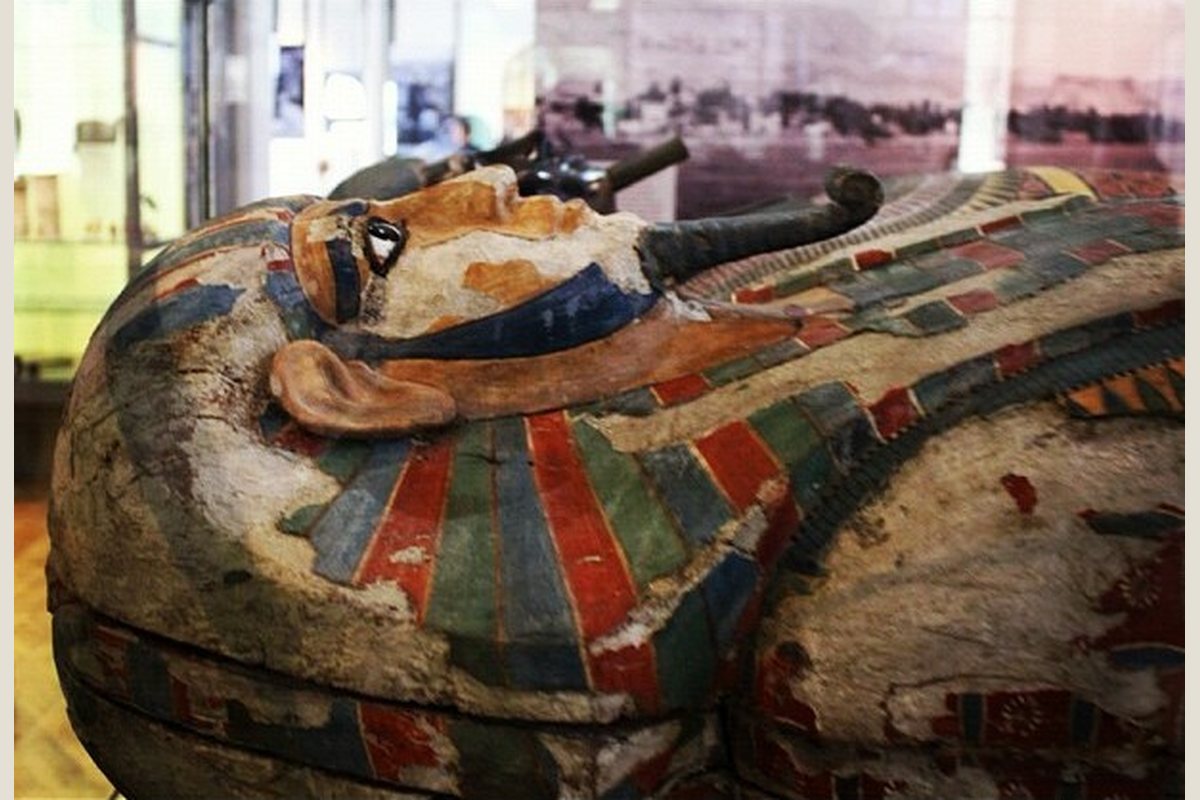
Objects near human size meet visitors as bodies, doubles, containers or equipment. A coffin can preserve a human outline while controlling access to remains; a garment extends around movement; a statue constructs posture and viewpoint. Similar height does not mean similar function. Compare how dimensions, stance, enclosure and display position organize relationships between the represented body, the ancient audience and your own body in the gallery.
Use stated dimensions, not eye contact
Perspective, plinths and camera angle distort size. Copy height, width and depth, then note mount height separately. A life-sized label should be treated as an approximation unless dimensions and comparison support it. Stand at the permitted viewing position and record where your eye meets the object. Present alignment is a curatorial condition, not necessarily the intended ancient viewpoint.
Distinguish body, container and image
A coffin relates to a body through enclosure and form, but its painted surface creates another idealized identity. Clothing surrounds and moves with a body; sculpture may stand for presence without matching anatomy exactly. Name each relationship rather than grouping everything as portraiture. Material, inscription, archaeological context and ritual role can outweigh simple physical resemblance.
Read posture as constructed geometry
Frontality, stride, seated pose, crossed arms and head angle distribute weight and direct viewing. Supports, back pillars, joins and garment shapes make the pose materially possible. Describe feet, base, centre line and open spaces. Do not turn formal posture automatically into personality. Compare objects of similar date, type and setting before interpreting difference as an individual psychological trait.
Look for zones of access
Faces, hands, feet, doors, lids and inscription bands can organize approach and handling. A coffin may have been moved, opened, nested or placed within architecture; a statue may receive offerings or remain elevated. Current case access is different. Use archaeological and textual evidence to reconstruct ancient proximity, and do not infer repeated touch from visual prominence alone.
Restore layers around the body
A coffin can belong to nested cases, wrappings, ornaments, a burial chamber and a wider assemblage. A garment may include underlayers, belts and accessories. A statue may be part of a pair or architectural program. Museum isolation makes the single human-scale object legible while reducing those relationships. Use plans and group records to rebuild layers without pretending the original setting survives intact.
Treat colour and surface as spatial
Paint, gilding, inlay and polish change how a human-scale form reads across distance. Strong contrasts may organize features for dim or directional light. Present losses can make carved volume dominate more than intended. Compare protected pigment, institutional reconstruction and the visible surface as separate evidence. Avoid repainting mentally from a few traces or a generalized palette.
Include movement and labour
Human-scale objects can be too heavy, fragile or complex for one person to move. Handles, sledges, ropes, bearers, architectural routes and coordinated installation may be part of use. Do not infer an exact transport system from mass alone. Published excavation, experimental work and inscriptions can support the sequence. Modern rigging, mounts and transport add a later phase worth recording.
Build a body relation sheet
Draw three silhouettes: represented or enclosed body, probable ancient viewer, present museum viewer. Mark height, orientation, barrier and viewing distance. Add solid lines for documented relationships and dotted lines for hypotheses. This diagram prevents your current face-to-face encounter from becoming the only or original meaning of a human-scale object.
Account for incomplete bodies
A head, torso, foot or textile panel can retain human scale even when the body is absent. Record the surviving dimensions first, then the estimated complete form only from a cited reconstruction. Fragmentary scale affects display: a small plinth can raise a head into face-to-face contact that the original statue never offered. Present encounter and ancient whole require separate descriptions.
Use published dimensions. Respect barriers. Separate present display, documented original setting and later digital enlargement.
Institutional sources reviewed 29 July 2026: Egyptian Museum ↗ · National Museum of Egyptian Civilization ↗. Displays and visitor conditions may change.