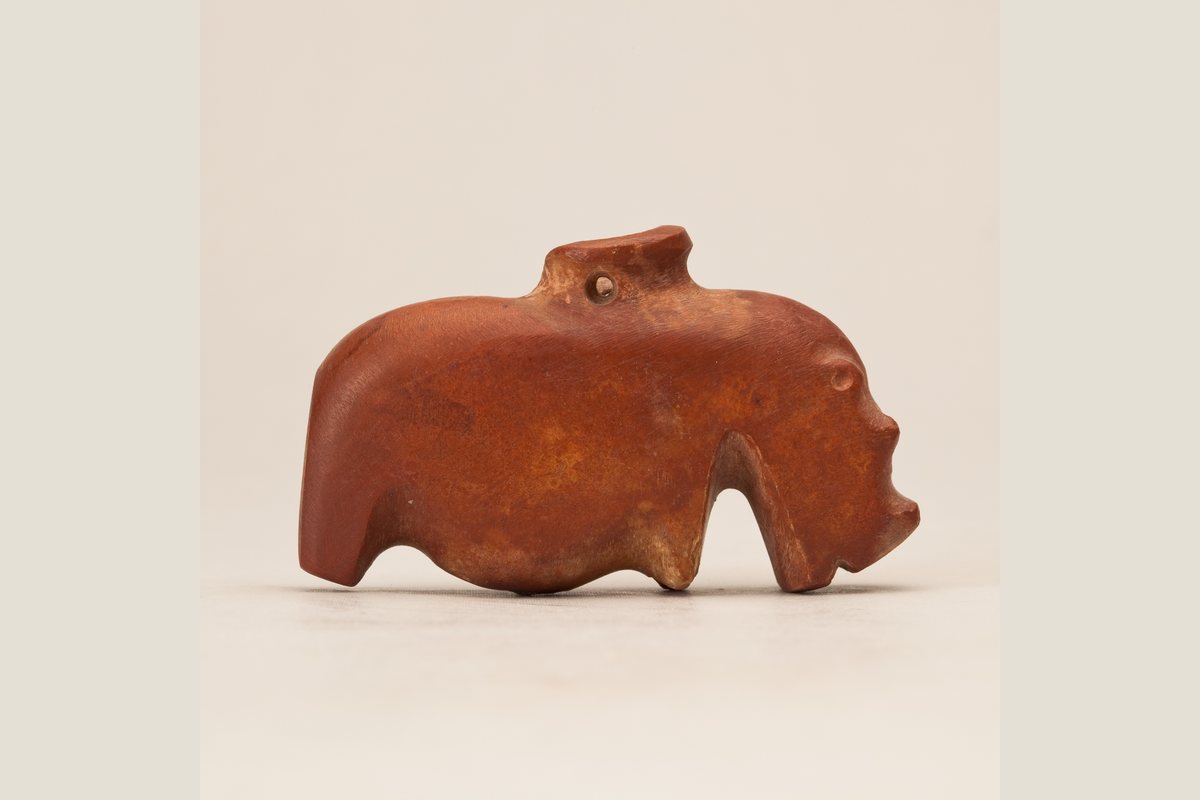
A palm-sized object creates an immediate illusion of intimacy. It looks graspable, portable and personally owned, even though a museum case correctly removes touch and the archaeological record may not identify one user. Small scale affects making, visibility, movement and loss. Study how the object met a body or container, then keep present museum display separate from its earlier zones of access.
Confirm size instead of estimating from the photograph
Copy dimensions in millimetres or centimetres and note whether they include a mount. A tightly cropped image can make an amulet monumental, while a crowded case can make it disappear. Draw a rectangle at stated size if practical. This establishes a reliable physical reference without placing your hand against the case or using an uncalibrated photograph as measurement.
Find the attachment system
Look for a perforation, loop, channel, suspension ring, flat back or worn edge. These features can connect a small object to thread, clothing, jewellery, a container or another support. An empty hole does not prove exactly how it was worn. Record orientation, wear and label interpretation separately, and check whether the present museum mount hides a reverse or blocks the original attachment point.
Treat handling as a hypothesis
Rounded projections, localized polish and dirt in recesses may relate to repeated contact, but burial, cleaning and modern movement can also alter surfaces. Ask which areas a grip, string or neighbouring bead would reach. Use wear studies or institutional records before claiming habitual touch. The goal is to map possible contact without inventing a vivid private ritual from one smooth edge.
Make visibility situational
A small pendant can be visible at close conversational distance and nearly disappear across a room. Colour, shine, contrast, movement and placement affect recognition. Ask who could see the object while it was worn or used, and whether a motif faced outward. Do not assume that tiny carving was intended for constant public reading; scale may organize restricted, mobile or occasional visibility.
Include containers and groups
Small objects are easy to separate in collecting and display. A bead may belong to a strand; an amulet may come from a group, wrapping, burial assemblage or foundation deposit. Copy the find context and neighbouring inventory numbers. A typological case assembled from different sites supports comparison, but it does not recreate an archaeological group. The distinction changes what relationships you can responsibly claim.
Ask how it was made small
Miniature carving, drilling, moulding, glazing and polishing require control at a scale where tiny errors can alter attachment or legibility. Look for mould seams, drill direction, repeated outlines and simplified volumes. Repetition may suggest organized production without making every item identical. Compare at least three examples before deciding which variations follow technique, material behaviour, period or later condition.
Track the risk of movement
Portability enables circulation, gifting, repair and reuse; it also makes loss, redeposition and undocumented collecting easier. A small object’s present location may be far from production or ancient use. Do not convert material source into a complete travel route. Use provenance, excavation records and institutional acquisition history to build movement one documented step at a time.
Make a contact map
Sketch the outline and shade probable contact, attachment and protected areas in different patterns. Add a question mark wherever display prevents a view. Then list the evidence for each zone: visible polish, perforation, label statement or comparison. The exercise recovers bodily scale while preventing the imagined hand from becoming more certain than the surviving object.
Compare presence with likely absence
Small durable objects can survive where thread, wrapping, pouch or body tissue does not. The remaining amulet or bead may therefore look more independent than it once was. List the missing soft materials and attachment systems that context makes plausible, but label them as losses or questions. This restores scale relations without fabricating a complete costume or deposit.
Use published dimensions. Respect barriers. Separate present display, documented original setting and later digital enlargement.
Institutional sources reviewed 29 July 2026: Egyptian Museum ↗ · Petrie Museum ↗. Displays and visitor conditions may change.